






How to Choose an Ultrasonic Food Cutting Machine
How to Choose an Ultrasonic Food Cutting Machine
How do you choose an ultrasonic food cutting machine? The right answer is not the highest power — it is the configuration that matches your product. Conventional blades squeeze food apart and cause deformation, sticky cut faces, crumbs, uneven thickness and high scrap. An ultrasonic food cutting machine separates food with high-frequency vibration instead of compression, giving soft, sticky, layered and filled products a clean, smooth cut face. This buying guide walks through seven selection steps — product type, generator power, frequency, blade and horn, working mode, hygiene design, and precision plus after-sales — and includes comparison tables for cake, bread and cheese so you can specify the right ultrasonic cake cutter, ultrasonic bread cutter or ultrasonic cheese cutter for your line.
✅ Key Takeaways
- When you choose an ultrasonic food cutting machine, product type is the first filter: cake, bread and cheese need different blade geometry, amplitude and power.
- 20 kHz is the mainstream frequency for food cutting; 30–40 kHz suits delicate, thin or high-precision portions.
- Power bands: 200–500 W for labs and small batches, 600–1000 W for medium cake and bread lines, 1000–1500 W for high-viscosity cheese and high-speed inline lines.
- Always choose automatic frequency tracking — it compensates drift from blade heating during long production runs.
- Ask for a sample cutting test on your own product before signing; it is the only reliable way to avoid a wrong selection.
1. Quick Answer: The 7-Step Selection Framework
-
If you only have two minutes, work through the seven checkpoints below in order. Each one eliminates a group of unsuitable ultrasonic food cutting machines, so by step seven the specification is usually narrow enough to request a quotation and a sample cutting test.
-
Step What to Decide Typical Output 1 Product type, size, temperature and filling structure Product list + target slice thickness 2 Generator power band 200W–1500W selection 3 Operating frequency 20kHz / 30kHz / 40kHz 4 Blade material, shape, thickness, quick-change Blade spec sheet 5 Working mode: handheld / tabletop / inline Machine form factor 6 Hygiene design, IP rating, cleaning method IP65 + CIP requirement 7 Precision tolerance, spare parts, service Acceptance criteria
2. Step 1: Confirm Your Product Type
Food materials differ widely in hardness, viscosity, elasticity and filling structure, and those properties directly determine the blade, power and vibration parameters you need. Start by writing down every product the machine must cut, including its temperature at the cutting station.
| Product Group | Characteristics | Recommended Configuration |
| Pastry & cake (ultrasonic cake cutter) | High cream ratio, very soft, easy to deform and stick to blade | Low and stable amplitude + thin food-grade blade; avoid cream squeeze-out and filling overflow |
| Mousse, cream cake, sponge, layer cake, filled cake | ||
| Bread & toast (ultrasonic bread cutter) | Porous interior, crumbs easily | Anti-crumb cutting configuration; no compression of the crumb structure |
| Soft toast, sandwich bread, European bread, filled bread | ||
| Cheese (ultrasonic cheese cutter) | Very high viscosity, strong adhesion to blade | Dedicated anti-stick blade + matched generator parameters; hard cheese needs higher power |
| Hard cheese, soft cheese, cream cheese, blended blocks | ||
| Confectionery & bars | Sticky, elastic, tends to drag | Narrow kerf blade, controlled feed speed |
| Nougat, marshmallow, cereal bar, energy bar | ||
| Frozen desserts | Hard shell, needs clean fracture | Reinforced blade, higher amplitude, mild-chill cutting window |
| Frozen cake, ice cream dessert |
Note: one machine can usually cover several similar products, but a very hard cheese and an ultra-soft mousse cake cannot share exactly the same vibration setting. Plan for a quick-change blade and a saved parameter recipe per product.
3. Step 2: Match the Ultrasonic Generator and Power
The ultrasonic generator is the heart of an ultrasonic food cutting machine. For continuous bakery production, always specify automatic frequency tracking: it compensates the frequency drift caused by blade heating and long running time, and prevents weak cutting and inconsistent cut faces during long shifts.
| Power Band | Typical Application | Notes |
| 200W – 500W | Lab, R&D, small pastry shop, sample making | Lowest entry cost, not for mass production |
| 600W – 1000W | Medium cake and bread production lines | Most common configuration for an ultrasonic cake cutter |
| 1000W – 1500W | High-viscosity cheese, large blocks, high-speed continuous lines | Highest cutting force, needs rigid frame and cooling |
Oversizing power is not harmless: an over-powered generator on a soft mousse cake increases amplitude beyond what the product needs and can damage the aerated structure. Match power to the hardest and largest product on your list, then trim amplitude downward for softer items.
4. Step 3: Choose the Frequency — 20 kHz, 30 kHz or 40 kHz
| Frequency | Cutting Behaviour | Best For |
| 20 kHz | Larger amplitude, stronger cutting force, mature and widely used | Bread, cheese, frozen products, thick and dense items |
| 30 kHz | Balanced force and fineness | Multi-layer cake, filled pastry, medium-thickness slices |
| 40 kHz | Smaller amplitude, finer and gentler cut | Thin slices, delicate mousse, high-precision portioning |
Most food cutting applications adopt 20 kHz, which remains the mature mainstream frequency for bakery, bread and cheese cutting. Move to 30 or 40 kHz only when your product is very delicate, very thin, or when portion tolerance is extremely tight.
5. Step 4: Select the Cutting Blade and Horn
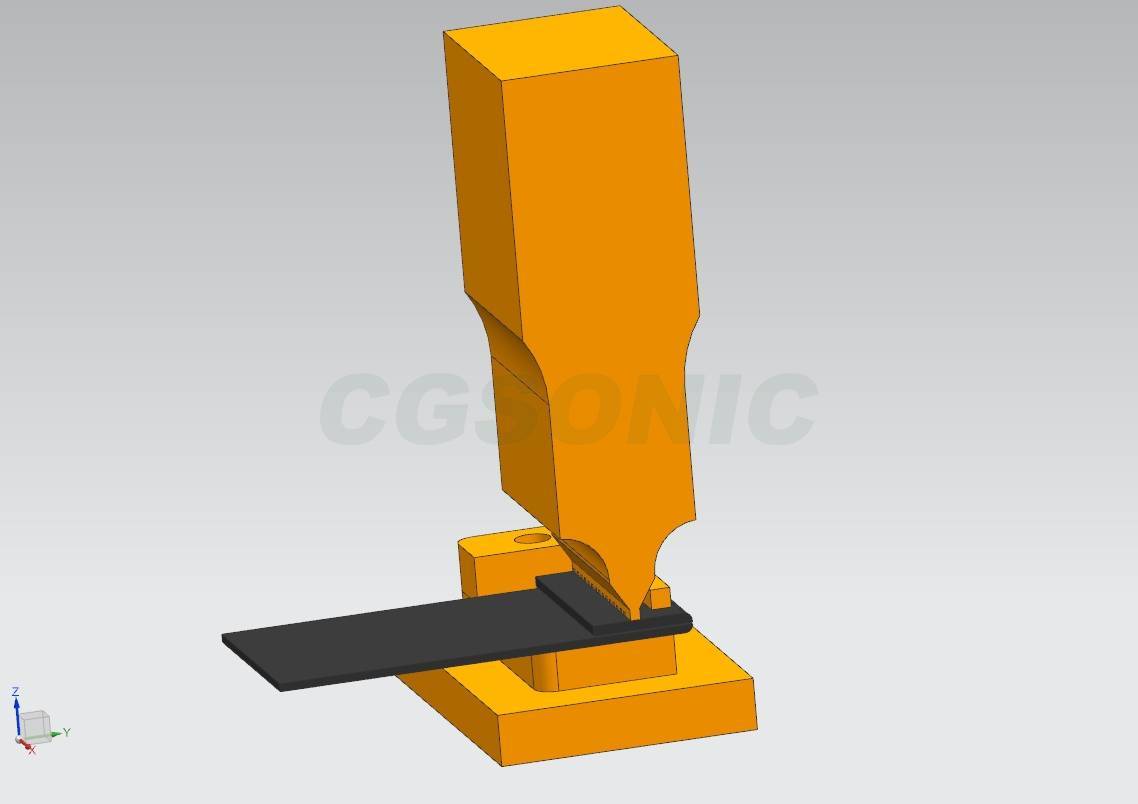
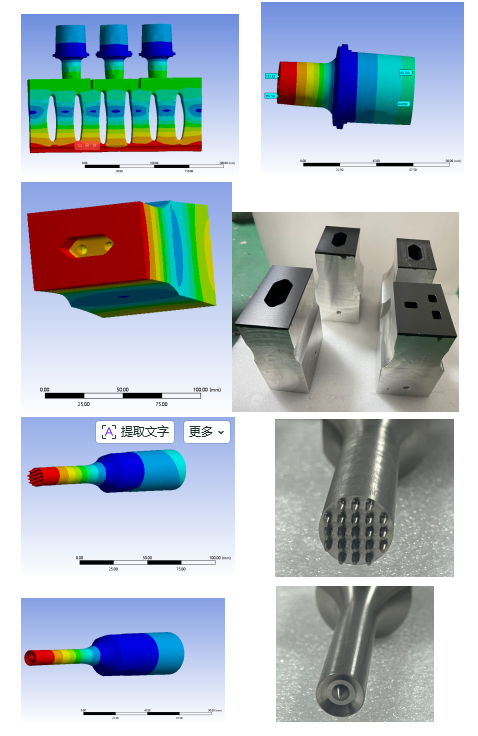
On any ultrasonic food cutting machine, the blade is the only part that touches the food, so it has the largest influence on cut quality. The horn (booster) behind it transmits and scales the vibration, and the two must be designed as a matched set.
✅ Material
Specify food-contact-safe material. The horn and sonotrode body is normally food-grade titanium alloy (Ti-6Al-4V) because of its acoustic efficiency and fatigue strength; blades are commonly supplied in food-grade 316L stainless steel or titanium. Either way the parts must be easy to strip down, resistant to high temperature and corrosion, and compatible with CIP cleaning.
✅ Blade shape and thickness
| Blade Type | Application | Why |
| Thin straight blade | Cake, mousse, cream pastry, thin slices | Minimal kerf, cleanest cut face |
| Reinforced thicker blade | Bread, large toast blocks | Reduces blade wobble on tall products |
| Wide / segmented blade | Large cheese blocks | Distributes load, prevents sticking over wide area |
| Quick-release blade | Plants with frequent product changeover | Cuts changeover and re-tuning time |
Bakery factories change products frequently, so a quick-change blade structure usually pays for itself within months. Confirm how many blade sets are included and how long a changeover takes.
6. Step 5: Pick the Working Mode — Handheld, Tabletop or Inline
| Dimension | Handheld Ultrasonic Food Cutter | Tabletop Semi-Automatic | Inline Automatic System |
| Investment | Lowest | Medium | Highest |
| Output | Low, manual pace | Medium batch | High, continuous |
| Flexibility | Highest; irregular shapes, trimming | Fixed stroke and size | Fixed to line layout |
| Consistency | Operator dependent | Repeatable within fixed size | Highest, servo controlled |
| Typical user | Bakery shop, workshop, R&D | Workshop, medium plant | Large bakery and dairy plants |
| Best match | Samples, custom shapes | Fixed-size cake and cheese blocks | High-volume standard portions |
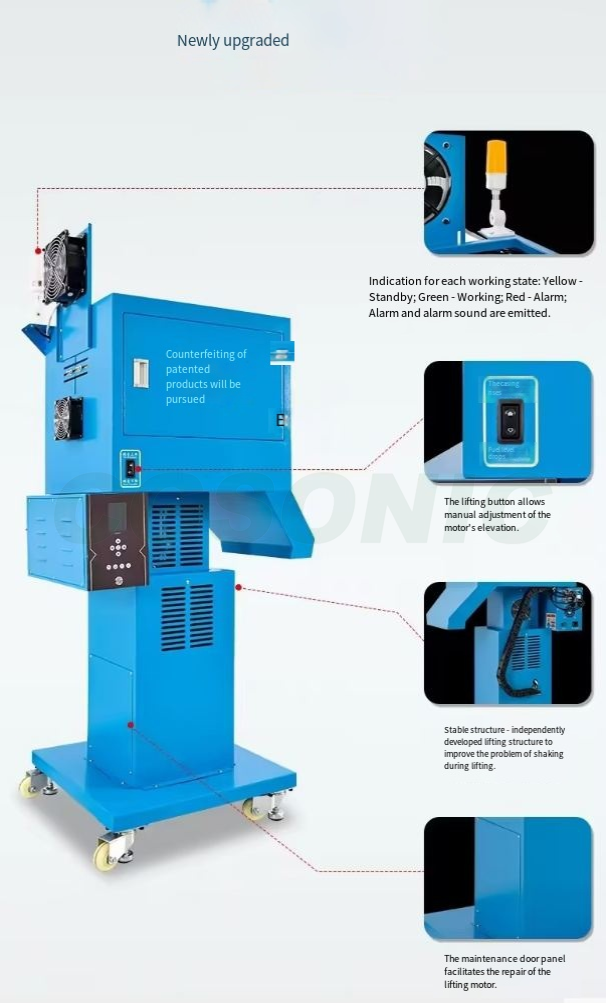
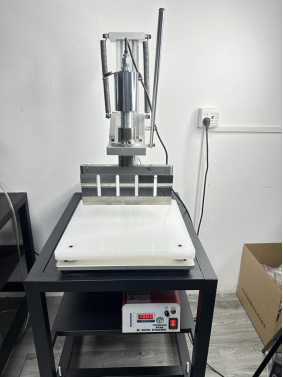
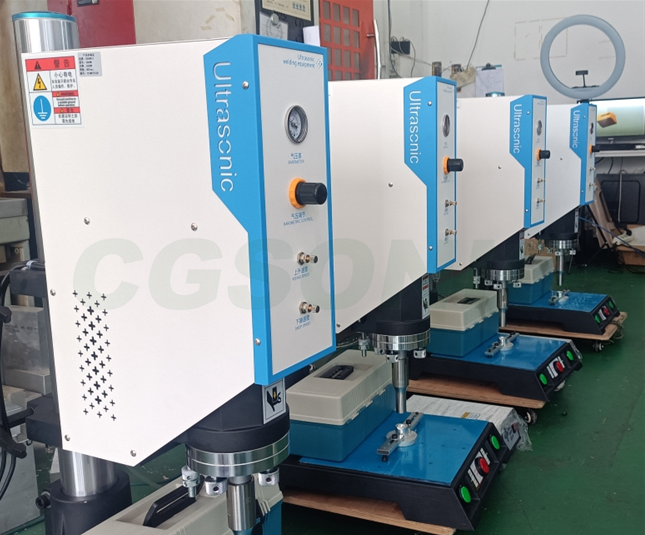
A practical path many plants take: start with a handheld or tabletop unit to validate the cut quality and build the parameter recipe, then scale to an inline system once the product and volume are proven. The tabletop ultrasonic cake cutter is the most widely used configuration on the market.
7. Step 6: Verify Hygiene and Cleaning Design
Food production hygiene standards are strict. Whatever ultrasonic food cutting machine you shortlist, the goal is the same: eliminate every dead corner where cream, bread crumbs and cheese residue can accumulate.
- Preferred: split design with independently detachable blade and horn, no hidden gaps.
- Protection rating: IP65 is recommended for workshop washdown environments.
- Avoid: integrated sealed structures that are hard to strip down and can breed bacteria.
- Confirm cleaning method: manual strip-down, CIP, or both — and the maximum water temperature allowed.
- Check that the generator cabinet and cable glands are rated for the same washdown conditions.
8. Step 7: Confirm Precision, Tolerance and After-Sales Support
✅ Precision requirement
If you sell standardized pre-packaged pastry, portion weight consistency is a compliance issue, not just a quality preference. Confirm the slice thickness tolerance and portion weight deviation of the equipment in writing before purchase, and ask how it is measured.
中文:如果销售标准化预包装糕点,克重一致性属于合规问题,而不仅是品质偏好。采购前要以书面形式确认设备的切片厚度公差与克重偏差,并问清测量方法。
✅ After-sales and spare parts | 售后与备件
- On-site commissioning and operator training included?
- Continuous supply of consumables: transducer, blade, generator, booster.
- Response time and warranty period for the ultrasonic stack (generator + transducer + booster).
- Is a loaner or backup blade set available during blade re-grinding?
9. Selection Focus by Product: Cake VS Bread VS Cheese
| Selection Item | Cake & Pastry | Bread & Toast | Cheese |
| Priority | Clean cut face, no cream smearing | Anti-crumb, no pore compression | Anti-stick blade |
| Frequency | 20kHz / 30kHz | 20kHz | 20kHz |
| Amplitude | Low and stable | Medium | Medium–high |
| Power | 600W–1000W | 600W–1000W | 1000W–1500W(hard cheese |
| Blade | Thin straight, food-grade | Reinforced thicker | Wide anti-stick / segmented |
| Working mode | Tabletop or inline | Inline | Tabletop or inline |
| Typical defect avoided | Deformation, filling overflow | Crumbs, uneven slices | Blade dragging, rough surface |
10. Five Common Selection Mistakes
- Buying the highest power available. Excess amplitude damages soft, aerated structures — match power to your hardest product, then tune down.
- Specifying the ultrasonic food cutting machine before listing the products. Without a product list, temperature window and target thickness, no supplier can configure your machine correctly.
- Ignoring blade material and food-contact certification. Ask for the material certificate and food-contact compliance document.
- Skipping the sample cutting test. A 30-minute test on your own product eliminates most of the risk.
- Forgetting hygiene and cleaning access during layout design. Check washdown clearance before the machine is installed.
11. What to Prepare Before Requesting a Quote
Send the following to your ultrasonic food cutting machine supplier and you will receive an accurate configuration, a matched blade recommendation and a firm quotation instead of a generic brochure.
- Product list: name, dimensions, weight, filling structure, and temperature at the cutting station.
- Target slice thickness, portion weight and tolerance.
- Required output: pieces per hour and shift pattern.
- Existing line: conveyor width, line speed, available floor space and utilities.
- Hygiene requirement: washdown method, IP rating, CIP or manual cleaning.
- Product samples or photos for the cutting test.
12. FAQ
Q1: Can one ultrasonic food cutting machine cut both cake and cheese?
A: Yes, most machines cover both, but you should change the blade and reload the matching ultrasonic parameters for each product. Hard cheese needs a wider anti-stick blade and higher power, while cream cake needs a thin blade and lower amplitude. Save a parameter recipe per product so changeover takes minutes.
Q2: Will ultrasonic cutting melt cake cream?
A: No. Food-grade ultrasonic cutting at 20 kHz generates very little heat because the energy concentrates at the separation interface and contact time is extremely short. As long as the amplitude and feed speed are set correctly, cream and chocolate coatings will not melt — this is why ultrasonic cake cutters outperform friction-based saws.
Q3: What is the service life of an ultrasonic cutting blade?
A: It depends on the material being cut. Cake and pastry cause slow wear, while hard cheese and frozen products wear blades faster. Titanium blades generally last longer than stainless steel but cost more. Plan blades as a scheduled consumable and keep at least one spare set on site.
Q4: What power do I need — 500W, 1000W or 1500W?
A: Use 200–500 W for labs, R&D and small pastry shops; 600–1000 W for medium cake and bread lines, which is the most common ultrasonic cake cutter configuration; 1000–1500 W for high-viscosity cheese, large blocks and high-speed continuous lines. Size the generator to your hardest, largest product, then lower the amplitude for softer items.
Q5: Should I choose 20 kHz or 40 kHz?
A: Choose 20 kHz by default — it is the mature mainstream frequency for bread, cheese and general bakery cutting, with larger amplitude and stronger cutting force. Choose 30–40 kHz only when you cut very thin slices, very delicate mousse, or need extremely tight portion tolerance.
Q6: Handheld, tabletop or inline — how do I decide?
A: Decide by output and product variety. Handheld suits shops, workshops, irregular trimming and sampling; tabletop semi-automatic suits fixed-size cake and cheese blocks at medium batch volume; inline systems suit large bakeries and dairy plants that need continuous feeding, high speed and servo-controlled portion consistency.
Q7: Can an ultrasonic food cutter be retrofitted onto my existing conveyor line?
A: In most cases yes. Retrofit projects usually keep the existing conveyor and packaging equipment and add an ultrasonic cutting station plus a servo indexing unit. The critical checks are line speed matching, product height clearance, washdown access around the cutting zone and the control-system handshake with your existing PLC.
Q8: Why is a sample cutting test necessary before buying?
A: Because cut quality depends on the interaction between your specific recipe, temperature, filling and the vibration parameters — no datasheet can predict it. A sample test shows the real cut face, crumb level, thickness tolerance and sticking behaviour, and it gives both sides an objective acceptance standard.
13. Conclusion
The best ultrasonic food cutting machine is not the one with the highest power — it is the one that matches your products. For cake and cream pastry, look for stable low-amplitude vibration plus a thin food-grade blade. For bread and toast, prioritise anti-crumb cutting performance. For cheese, focus on the anti-stick blade and matched ultrasonic parameters. Whether you need a handheld unit for sampling, a tabletop ultrasonic cake cutter for your workshop, or an inline automatic system for a factory line, clarify your product list, daily output and workshop cleaning requirements first, then arrange a sample cutting test with your supplier. That sequence is the most reliable way to avoid a wrong selection.