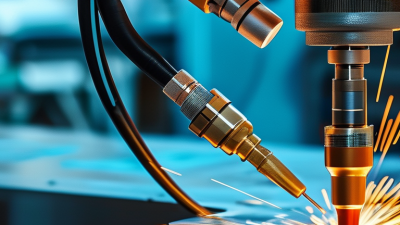
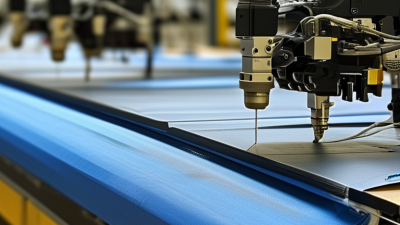
So, you’re wondering what kind of welding is used when making syringe parts? Well, it’s not just about sticking things together haphazardly — the process needs to be precise and controlled. Usually, manufacturers turn to Ultrasonic Welding when working with materials like polypropylene and polyethylene — you know, those plastics used for caps, plunger assemblies, and molded hubs. This method uses high-frequency vibrations to generate heat right at the joint, which makes it super fast, pretty clean, and perfect for automating medical device production.
Now, laser welding is also a key player, especially when parts need a super narrow and exact seam. It’s great for joining both transparent and opaque plastics with minimal mess — like little flashes or extra stress on the material. Resistance welding? That’s a bit more specialized and less common for small polymer syringe parts, but it’s out there. Think of Electronic Component Welding—it follows a similar idea: steady energy, precise alignment, and thorough inspection matter more than just speed.
Dr. John C. Lippold, a well-known expert in welding metallurgy, once said, 'The weld must be designed around the service requirements, not just the welding process.' That’s pretty much the golden rule when making syringes. The welds need to prevent leaks, withstand pressure, vibrations, and repeated handling. Plus, they shouldn’t have visible particles or end up deformed.
In real-life engineering, folks pay attention to things like horn design, clamping force, weld amplitude, cycle time, and even how moist the materials are. After that, they check if the joint can handle burst pressure, if it pulls apart easily, if it fits right, and if the seal actually works. Things like ISO 13485 standards and ISO 7886 syringe rules help guide the validation process. But here’s the thing — there’s no one-size-fits-all method. The right approach depends on the material color, wall thickness, shape, and even how many syringes you’re making. So, it’s important to be aware of these variables. Creating a great-looking weld is one thing, but if the interface isn’t designed well or the inspection plan isn’t thorough enough, it can still fail — no matter how pretty it looks.
What Type of Welding Is Used for Syringe Components?
Syringe Components That Require Welding
Syringe components usually require welding when two molded plastic parts must form a clean, leak-resistant connection. Common examples include barrel tips, luer-style fittings, needle hubs, protective caps, and internal plunger parts. The exact joint depends on the resin, wall thickness, and required pressure resistance.
Ultrasonic welding is widely considered for thermoplastic components. High-frequency vibration melts a small interface area, creating a fast joint with limited heat exposure. It can suit barrel-to-tip connections and cap assemblies. Laser welding offers precise, localized heating and may protect nearby transparent features. Spin welding can join round parts, but friction may create particles if process controls are weak.
Material behavior matters. Polypropylene, polycarbonate, and cyclic olefin polymers do not respond identically to heat or vibration. Engineers should check weld strength, dimensional change, visible flash, and particulate levels. A smooth surface is not proof of a reliable joint. I have seen attractive assemblies fail during leak testing because the energy director was poorly designed.
Manufacturers typically validate welding through pull tests, pressure tests, visual inspection, and aging studies. Cleanroom handling also matters, especially around open fluid paths. Welding parameters need control, including amplitude, pressure, hold time, and alignment. Small shifts can change the seal. The difficult part is not producing one good sample; it is repeating that result across production without damaging delicate syringe features.
What Type of Welding Is Used for Syringe Components?
Ultrasonic Welding for Plastic Syringe Parts
Ultrasonic welding is widely considered for joining plastic syringe components. It uses high-frequency vibration to create heat at a controlled joint. No solvent or added adhesive is required. The process can finish in less than a second, depending on the material and joint design. Common materials include polypropylene and medical-grade polyethylene. These plastics need compatible melting behavior and stable dimensions.
The scale of use makes reliability important. The World Health Organization estimates that about 16 billion injections occur worldwide each year, according to its Injection Safety Fact Sheet. Even a small sealing defect can affect many assemblies. Engineers should test leak resistance, weld strength, particulate generation, and dimensional accuracy. FDA process-validation guidance also stresses documented control of critical process parameters. Amplitude, weld energy, pressure, and holding time deserve close attention. A clean weld is not automatically a safe weld. The fixture may cause more variation than the welding horn. This point is easy to miss.
Tips: Use a defined energy window, not one fixed setting. Inspect weld surfaces under magnification. Run aging and transport simulations before production release. If the plastic flashes, the joint may be overdriven. If the interface looks weak, the design may need revision. Ultrasonic welding is efficient, but it is not perfect. Small changes in resin moisture, mold shrinkage, or component fit can alter results. Nakne
Ultrasonic welding is commonly used to join compatible thermoplastic syringe components, such as barrels, hubs, and protective caps. The chart compares typical melting-temperature ranges for plastics used in syringe construction.
Interpretation: Ultrasonic welding works best when the syringe parts are made from compatible thermoplastics and the joint is designed to concentrate ultrasonic energy. Polypropylene and polyethylene are frequently considered for plastic syringe components because they can be thermally softened and joined without adhesives. Actual welding settings depend on material grade, wall thickness, joint geometry, horn design, frequency, pressure, and weld time.
Temperature values are typical literature ranges and may vary by polymer grade, additives, and measurement method.
What Type of Welding Is Used for Syringe Components?
Laser Welding for Specialized Syringe Assemblies
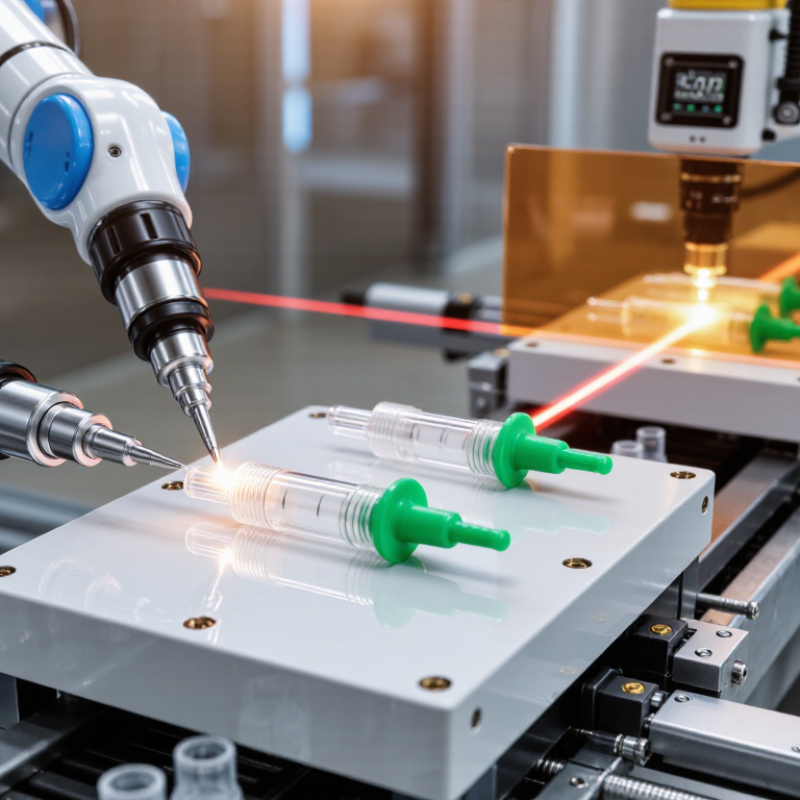
Laser welding is often selected for specialized syringe assemblies that require clean, precise, and controlled joining. The process uses a focused beam to melt a narrow interface between compatible polymer components. It creates minimal flash and reduces the heat-affected area around the joint. That matters near barrels, hubs, valves, and other small fluid paths.
In practical production, engineers first examine material behavior, wall thickness, and joint geometry. Some polymers transmit laser energy, while others absorb it. This combination allows energy to pass through one part and create a localized weld beneath the surface. Dissimilar Materials Welding may be possible, but it requires careful material selection and testing. Different shrinkage rates can cause stress, distortion, or weak bonding.
Process control is essential. Operators monitor laser power, exposure time, clamping pressure, and component alignment. A tiny gap can produce an incomplete seal. Too much energy may deform the assembly. Inline visual checks can identify surface defects, while pressure-decay or leak testing evaluates joint integrity. Clean handling also helps limit particles inside the fluid pathway. No process is perfect. Even a well-designed weld may need repeated trials when dimensions change slightly. Experienced teams document those results and refine the settings before routine production.
| Welding or Joining Method | Typical Syringe Component or Assembly | Compatible Materials | How the Process Works | Key Advantages | Important Considerations | Suitability for Specialized Syringe Assemblies |
|---|---|---|---|---|---|---|
| Laser Welding | Barrel-to-tip assemblies, needle hubs, dosing-device components, and small polymer subassemblies | Laser-compatible thermoplastics, commonly including selected grades of polycarbonate, polypropylene, polyethylene, and cyclic olefin materials | A focused laser beam creates localized heat at the joint while the parts are held together under controlled pressure. | Small heat-affected zone, precise energy control, clean non-contact processing, repeatability, and suitability for automated production | Material pairing, laser transmission, pigment, joint design, clamping, and process validation must be carefully controlled. | Excellent for precision assemblies where low debris, controlled heat input, and consistent sealing are required. |
| Ultrasonic Welding | Plastic syringe barrels, caps, protective shields, and high-volume component assemblies | Many compatible thermoplastic combinations, especially parts designed with an energy director | High-frequency mechanical vibration generates heat at the interface and forms a solid-state polymer bond. | Fast cycle times, no added adhesive, compact equipment, and efficient high-volume production | Vibration may affect delicate components; joint geometry, flash control, and particulate management are important. | Well suited to standardized plastic components produced in high volumes. |
| Spin Welding | Round plastic components such as caps, closures, and cylindrical interfaces | Compatible thermoplastics with suitable rotational joint geometry | One component rotates against another under axial pressure, producing frictional heat that melts and fuses the interface. | Strong circumferential joints, relatively simple tooling, and rapid processing for rotational parts | Not suitable for components that cannot tolerate rotation or for assemblies containing orientation-sensitive internal parts. | Useful for selected cylindrical designs, but less versatile than laser welding for delicate assemblies. |
| Hot-Plate Welding | Large plastic housings, barrel connections, and components with broad or irregular joint surfaces | Thermoplastics with compatible melting behavior | Joint surfaces are heated against a hot plate, brought together, and held until the molten interfaces cool and solidify. | Can join larger parts, accommodates some joint irregularity, and creates a broad welded area | Longer cycle times, greater heat exposure, possible surface marks, and more thermal impact on nearby features | Appropriate for larger assemblies where precision and minimal heat input are less critical. |
| Solvent Bonding | Selected plastic barrel, hub, or fitting connections | Polymers that can be softened or dissolved by a validated solvent system | A solvent softens the mating surfaces, which are then brought together and allowed to form a bond as the solvent evaporates or diffuses. | Can join complex geometries and requires relatively simple equipment | Residual solvent, cure time, chemical compatibility, dimensional changes, and regulatory requirements must be evaluated. | Used only when the materials and product requirements support solvent processing. |
| Adhesive Bonding | Needle hubs, labels or housings, dissimilar-material interfaces, and components with challenging geometries | Selected plastics, metals, glass, and elastomers depending on adhesive chemistry | An adhesive is applied between the surfaces and cured by time, heat, moisture, or light, depending on the formulation. | Joins dissimilar materials, distributes stress over a broad area, and can accommodate complex joint designs | Cure time, extractables, aging, moisture resistance, adhesive dispensing, and biocompatibility must be assessed. | A practical alternative when thermal welding is unsuitable, but it introduces an additional material into the assembly. |
| Mechanical Interference or Snap-Fit Joining | Protective caps, removable covers, plungers, and non-permanent component interfaces | Compatible rigid or flexible polymers with suitable dimensional tolerances | Parts are assembled through controlled interference, retention features, threads, or snap-fit geometry rather than melting. | No thermal cycle, no adhesive, rapid assembly, and possible disassembly for selected designs | Seal performance, retention force, dimensional variation, creep, and unintended separation must be verified. | Suitable for non-welded interfaces where serviceability or removable assembly is required. |

When engineers join syringe components, heat welding is often considered for thermoplastic parts. Controlled heat softens the contact surfaces without melting the entire barrel. A heated tool may join a tip cap, protective shield, or molded hub. The joint must remain smooth, leak resistant, and free from visible distortion. Excessive heat can create flash, blocked openings, or unwanted particles.
Ultrasonic Welding Equipment uses high-frequency vibration to generate heat at the joining interface. It can produce fast, repeatable joints with limited external heating. This method suits compatible plastic hubs, caps, and internal support parts. However, vibration settings need careful control. Too much energy may damage thin walls or affect dimensional accuracy. Laser welding can offer precise, localized joining, while mechanical snap-fits avoid added heat. Adhesive bonding is possible, but curing time, residue, and material compatibility require strict review.
In practical development, engineers compare joint strength, pull-off force, leakage, and particulate results. They also examine samples under magnification after aging and sterilization studies. There is no universal best method. A joint that looks clean can still fail during pressure testing. Heat welding may also need redesign when wall thickness changes. I have seen teams focus on speed and overlook fixture alignment. That mistake is costly. Reliable production depends on validated settings, trained operators, documented inspections, and materials suitable for medical use.
Manufacturers select a welding technique by studying the component, resin, and required seal. Ultrasonic welding is common for compatible plastic parts. It uses high-frequency vibration to create localized heat. The process is fast and usually produces clean joints. However, thin walls can deform under excessive energy.
Laser welding suits parts that need precise, controlled joining. It can reduce visible marks around a clear barrel or small fluid path. The materials must transmit and absorb the laser energy correctly. Heat welding remains practical for some thermoplastic assemblies. It is simple, but contact surfaces may show softening or slight distortion. This matters when a plunger moves through a tight barrel.
Engineers also examine particulate levels, leak resistance, cycle time, and equipment maintenance. A practical trial may include pressure testing, dimensional checks, and visual inspection under magnification. The first sample can look perfect and still fail after aging. That is why manufacturers test welded parts after temperature changes and repeated handling. Consumer Electronics Welding often emphasizes speed and appearance, while syringe production places greater weight on cleanliness and seal reliability. The comparison is useful, but not exact. A successful setting for one polymer may damage another. Operators should record weld energy, time, pressure, and fixture condition. Small changes matter. Admittedly, process selection is not always elegant; production teams may revise the method after early failures reveal hidden material stress.
For many syringe components, ultrasonic welding is the practical choice for compatible thermoplastics. It joins barrel parts, protective caps, and other molded pieces without adhesives. A horn applies controlled vibration and pressure, melting a narrow interface. This produces a clean seam with limited heat spread. Laser welding can suit precise metal assemblies or specialized polymer designs. It offers focused energy, but demands tighter alignment and process control. The correct method depends on material, geometry, sterility needs, and use conditions.
Quality begins with material verification, not the welding cycle. Engineers confirm resin compatibility, wall thickness, and joint design before trials. A Professional Welding Machine should provide stable force, amplitude, timing, and temperature monitoring. These settings need documented limits and trained operators. During production, technicians inspect weld lines, flash, deformation, and particulate residue. Pull tests and leak tests can reveal weak interfaces that look acceptable. Visual inspection alone is insufficient. That lesson is easy to forget when output targets become urgent. Every lot should retain machine data, inspection results, and corrective actions. Traceability supports investigation when a component behaves unexpectedly.
Safety requirements extend beyond joint strength. Components must avoid sharp edges, loose particles, chemical migration, and hidden channels. Validation should challenge normal production, transport vibration, aging, and sterilization exposure. Clean handling protects the weld after assembly. Packaging must prevent crushing, moisture intrusion, and accidental contamination. Experienced teams also review failure samples instead of discarding them quickly. Those samples often expose uneven energy, poor fit, or contaminated surfaces. Not every strong weld is safe. An over-heated joint may weaken nearby plastic or obstruct fluid movement. Careful records and honest rework decisions keep quality visible on the production floor.
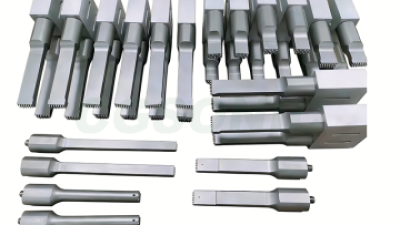
Ultrasonic Spot Welding Horn: Design, Applications, Benefits, and Selection Guide
Ultrasonic spot welding horns are precision-engineered accessories that convert and amplify ultrasonic vibration energy for localized plastic joining. Their geometry, resonant frequency, contact profile, and material strength must be carefully matched to the welding system and workpiece. With stable amplitude and evenly distributed stress, a properly designed horn supports clean spot welding, riveting, and bonding while reducing weak joints, glue overflow, and surface damage. This is increasingly relevant as global plastics production reached approximately 414 million metric tons in 2023, according to PlasticsEurope’s *Plastics—The Facts 2024*, creating demand for faster and more repeatable assembly methods.
In practical applications, customized horns are used for automotive interiors, electronic housings, medical components, packaging parts, and household products. They can be integrated into automated production lines or handheld ultrasonic welding devices, offering short cycle times, consistent energy transfer, and long service life. The International Federation of Robotics reported 541,302 industrial robots installed worldwide in 2023, highlighting the importance of tooling that can operate reliably within automated manufacturing environments.
When selecting a horn, engineers should evaluate the material and thickness of the plastic, joint design, welding frequency, required amplitude, accessible welding area, and expected production volume. High-strength industrial materials, accurate machining, and application-specific tuning help maintain uniform pressure and vibration. A customized horn is particularly valuable when standard tooling cannot provide sufficient bonding strength, dimensional consistency, or process efficiency.
Common parts include barrel tips, luer-style fittings, needle hubs, protective caps, and internal plunger parts. A clean joint matters.
Ultrasonic welding is widely considered for thermoplastic parts. It uses high-frequency vibration to melt a small interface quickly.
Laser welding suits precise joints near barrels, hubs, valves, and narrow fluid paths. It creates limited flash and a small heat-affected area.
Sometimes, but material selection requires careful testing. Different shrinkage rates may create stress, distortion, or weak bonding. Compatibility is not automatic.
Resin type, wall thickness, joint shape, pressure, alignment, amplitude, and hold time all matter. A tiny shift can change the seal.
No. A smooth surface can hide a weak joint or a leaking path. I would not trust appearance alone. Pull, pressure, and leak tests are necessary.
Friction may create particles when process controls are weak. Teams should monitor rotation, pressure, alignment, and cleanliness around fluid pathways.
Manufacturers commonly use pull tests, pressure tests, visual checks, and aging studies. Pressure-decay testing can reveal leaks that a visual inspection misses. One good sample is not enough.
Clean handling helps limit particles inside open fluid paths. Consistent settings help repeat the same seal across production. Small dimensional changes still deserve review.
Welding Of Syringe Components is an important manufacturing process used to create secure, leak-resistant connections in syringe barrels, tips, needle hubs, filter housings, and other assemblies. Plastic syringe parts are commonly joined through ultrasonic welding, which uses high-frequency vibration to generate localized heat and form clean, consistent bonds without adding adhesives. For specialized assemblies, laser welding can provide precise, controlled joining with minimal heat exposure, making it suitable for delicate or visually demanding components.
Heat welding and other mechanical or energy-based methods may also be selected according to the material, shape, wall thickness, and production requirements. Manufacturers evaluate bond strength, dimensional accuracy, cycle time, equipment compatibility, and the risk of contamination before choosing a technique. Quality and safety requirements remain essential throughout production, including inspection for leaks, cracks, incomplete bonds, and particle generation. Proper process validation and controlled manufacturing conditions help ensure that welded syringe components perform reliably and meet applicable medical-device standards.